I understand that the scope of this section is huge, and of course I do not seek to explore it in its entirety, but would like to write about my insights into this idea.
.
OVERVIEW
This piece is based on my GCSE art coursework, centralised around the theme of travel, predominantly in London and New York City (being the only locations I used here, although it is worth considering that my analysis might be applicable to travel and art more broadly). Throughout the project, I took my core photographs then abstracted them in a variety of ways, to manipulate the shapes and spaces in them, deconstructing and reconstructing them to dissemble and reassemble their meaning.
My project seeks to highlight how travel, and travel photography captures a snapshot of each place, which is then held and preserved in memory. This I found, was particularly significant in the locations where I based my work, which are extremely lively, bustling global hubs. I felt that my images thus appeared as a pause, or a brief moment of solace in the places that are constantly in a state of flux almost, feeling alive and in motion, the pictures thus providing a glimpse into the nature of each place.
As I deconstructed the images, this enabled me to reminisce and vicariously re-experience the moment, thus evoking further thought and recollection, which I found particularly useful for reconstructing the images as I felt a more vivid connection to them. Furthermore, I thought that it helped inform me further of how the place felt to me, thus influencing my artistic manipulation of each image as arguably one’s interactions with a place shape their experiences and memory of it.
.
CORE IMAGES
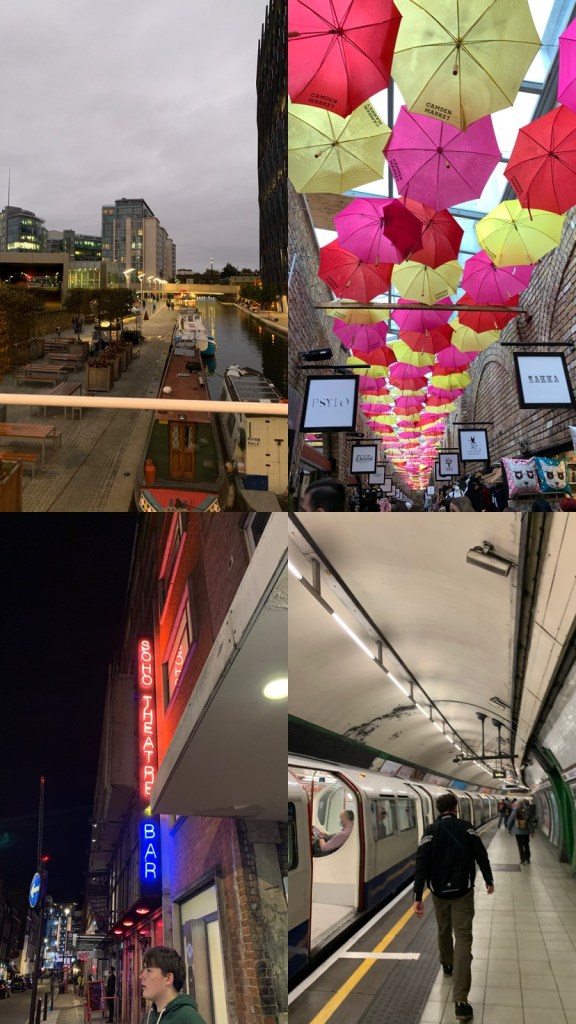
I felt that some of the images felt very reflective of the atmosphere of a place. For example, the Camden Market umbrella photograph (top right) looks vibrant, flamboyant and psychedelically immersive, which is entirely emblematic of my memory there. The vanishing point in the image creates a sense of perpetuality, which is again something I felt was true to the experience as the enveloping nature of the umbrellas seemingly stretched as far as the eye could see.
In the image of Soho (bottom left), the darkness and mystery creates a sense of intrigue, encapsulating the atmospheric sensation that I can still viscerally recall.
My photograph of the canals (top left) illustrates the city on the precipice of night, which created an interesting juxtaposition between the liveliness of the day, contrasted against the dimming light, as the capital somehow felt alive and asleep at the same time, the fusion of sensations highlighted in the visual composition of the image.
The tube photograph (bottom right) also shares an aesthetic correlation to the memories attached, as the image appears as slightly grungy and edgy, which relate to my memories here of anticipation and excitement, as I felt as though the abyss pictured in the vanishing point of the image well captured my unknowing expectations for the evening ahead.
.
METHODS AND MATERIALS
Through a range of mediums I was able to explore the nuances of each image. Starting with photography, then experimenting with pen and pencil, oil paint, sculpture, text, collage (most notably) to create the project through multiple dimensions.
This variety of techniques and materials made a stark difference to how the image appeared, giving alternatives for the presentation and interpreting the spaces. This I thought could be considered in a broader sense, almost as if each technique serves as its own lens, shaping and reshaping how the world seems, which is relevant when considering how individuals see the world differently. Sonder is a concept worth taking into account here; the idea that each individual has a different world view and their own unique set of experiences, which is somewhat incomprehensible considering the vast scale of the population. Each technique highlights how the images can appear markedly different as they are shaped by the manipulation of materials, linking to sonderous ideas as each individual interpretation of the place is shaped by their own experiences and context.
This manipulation of mediums and methods led me to consider the human impacts on the spaces and images on a wider scale, drawing on my knowledge in the anthropology of landscape, considering the idea of anthropocentrism, as my human input and manipulation of the images, was significantly changing the way that they looked, highlighting how impactful human influence can be on the environment, shaping the world and how we see it.
.
Line
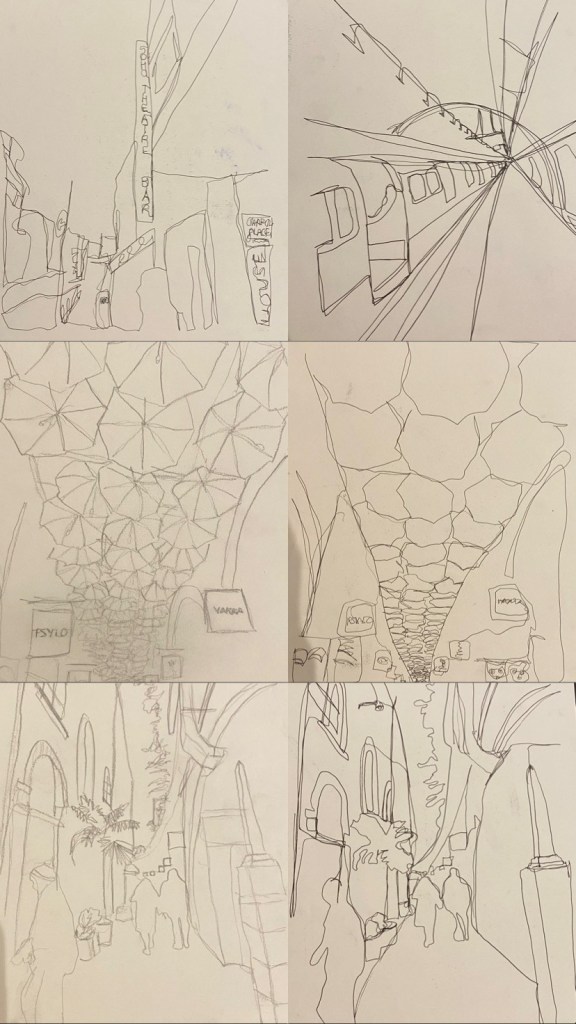
I explored the distortion of the line, by using a sharp pencil or fine-liner pen and one continuous line without removing the instrument from the page. I found that aspects of the image seemed to merge into each other, depicted in the buildings that seem to roll into each other or in the umbrellas that gently abstract into the distance.
This technique provided a definition in its simplistic nature, as there was an effective contrast between the dark outlines of the shapes against the light abyss of space that the page provided. I thought that this technique captured the dynamic imperfections of the image through this fluid obscurity.
.
Paint
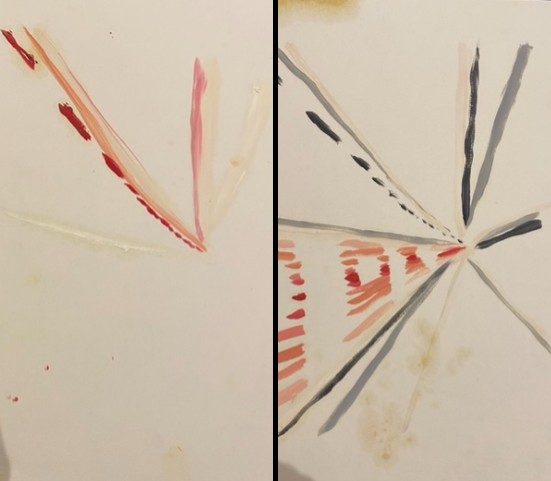
The addition of colour through paint gave the images more personality I thought, and perhaps more substance in the thick, definitive brushstrokes. This was not necessarily more or less effective in conveying the atmospheric sensations of the place, but instead enabled greater exploration of the images through alternative means. Sometimes however, the vibrance felt imposed, interrupting the viewer’s ability to interpret the image themselves however the medium arguably captured the aesthetics and the motion suitably, for example how the train moved swiftly through each station.
.
Collage
As I disassembled the images, I began to notice that some fragments were very similar in terms of their shape, and some were virtually identical, meaning I was able to swap the shards over. The best example is the MoMA (New York) and SOHO (London) signs, which perfectly fit. This abstractness appealed as it felt as though the images could be reduced to a jigsaw of sorts, with the pieces complementing each other despite their aesthetic contrast. I found this discovery particularly intriguing, as the shards of these two megacities seemed to fit perfectly into one another, further depicting the fusion and hybridity both cities emulate.
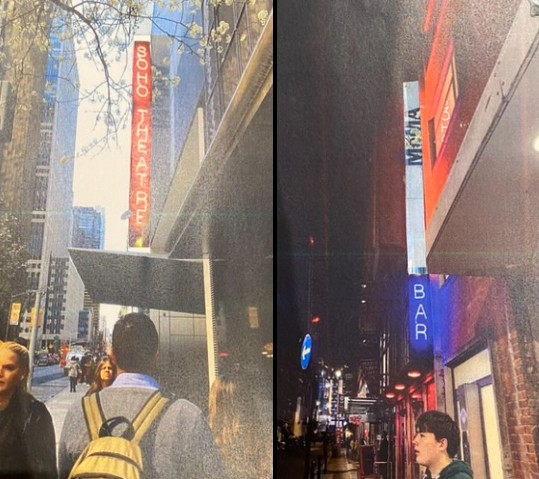
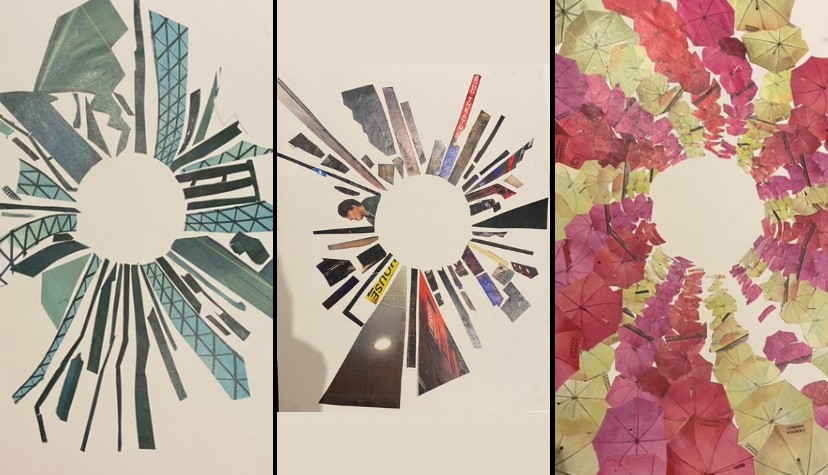
The further deconstruction of the images and arrangement of fragments around the circle was arguably the most abstract exploration of each image. This enabled me to look further into the nuances each photograph had, by fully deconstructing and reconstructing them.
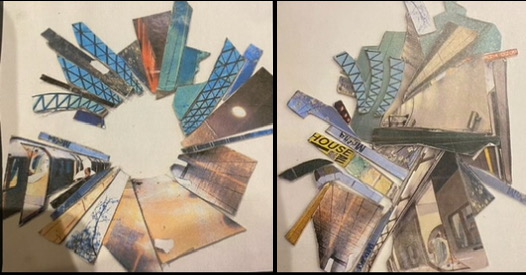
The circle motif was relevant to my project as it related well to the theme of travel in various ways. In terms of shape, it is the same as a camera lens and a globe, both key aspects to my project, but also represents the cyclical nature of travel, representing a journey around each image such as the journey around the world.
.
Text
Removing areas of the image and replacing them with text enabled me to explore the image through memory more directly, as the environment acted as a cue to my stream of consciousness, triggering a thought evoking recount of conversation.
Spatially, this was open to further manipulation and exploration as I could put the words into the image closely packed or sparsely scattered, in lower case or upper case, which all had notably different effects on how the image appeared. This had some correlation to the intensity of the memory, as some spaces felt tranquil and peaceful whereas others were riddles with worry and concern.
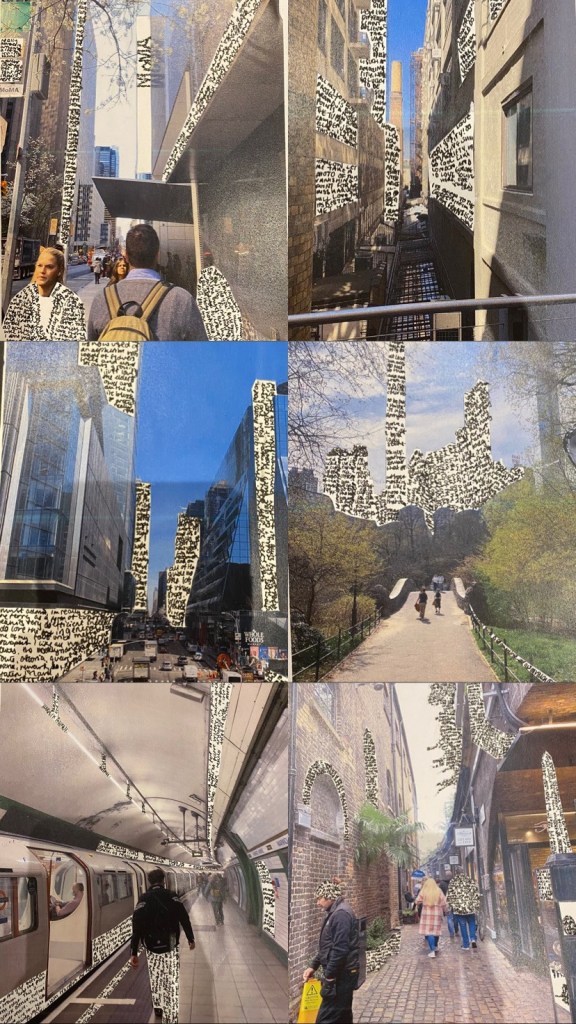
In my annotations, particularly as I started to incorporate words into the images, I found that each place felt significant to me because it has a memory, and thus a wider personal meaning to me. In the images, I transcribed conversations that I was having with my family, and found upon reflection, that each place had a deep semantic resonation with me, which is perhaps why I find travel to be so intriguing and beneficial, as each place captures a significant meaning.
And yet, these were only my experiences, and my memories, yet hundreds, thousands, millions, potentially billions of people might have been to the same places, and each had their own unique perspective on the place, with their own unique set of memories attached, linking to the aforementioned sonderous feel. This is another reason that I find travelling to be so intriguing, as the sheer breadth for unique interpretation of each place is incomprehensibly vast.
.
Sculpture
I began sculpture by physically manipulating each shard, twisting them. Though fairly simplistic, I found this to be individually impactful, both aesthetically and semantically. I thoughts that twisting the shards reflects how memories became twisted and warped over time, and how the internal narrative and recollection of the place and events attached to it changes and deteriorates over time.
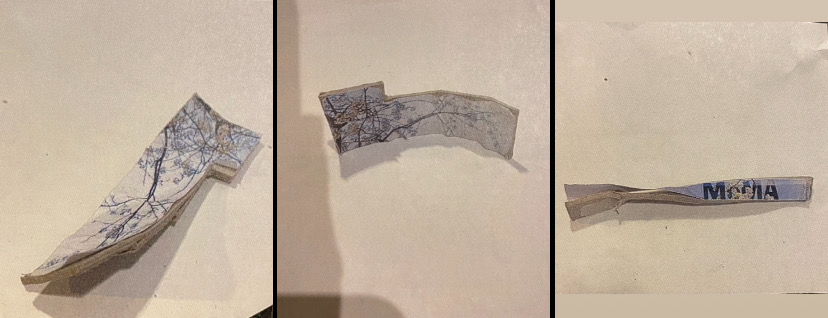
When I scaled this up to 3D arrangements of the shapes, this felt evocative on another level as the chaotic, fragmented nature of this was overwhelming and so intensely immersive, the fusion of places becoming so incomprehensible as the piece combined shards from all over London and New York in a random layout (note – I do not have photographs of this).

 anthropolitics